Caring for Kids & Families: Pediatric Associates in Western Colorado
Pediatric AssociatesMontrose, Colo.



For many families in Colorado’s Delta and Montrose counties, Pediatric Associates is the first and primary point of care for their children. With a focus on innovation and quality improvement, the group has for 30 years adapted to the changing needs of the diverse communities it serves in the Western Slope region.
In the Western Slope region of Colorado, geography looms large in the lives of its residents. Jagged mountain peaks separate its towns from the urban centers of Denver and Boulder on the east side of the Continental Divide. The high desert makes for dry, hot summers, and in the winter, snowstorms can make mountain passes treacherous or impassable.
With the closest major medical centers and children’s hospital located over the mountains in Denver, and other pediatric groups located 60 plus miles away, Pediatric Associates serves as the first and primary point of care for its patients.
“We are the only pediatrician group in the area,” says Amber Hickert, practice manager for Pediatric Associates.
An office in Montrose and a satellite clinic in Delta serve surrounding communities including Gunnison, Ouray, Telluride, Crested Butte and Ridgway. Pediatric Associates treats roughly 150 patients per day between two locations.
The Delta satellite clinic, established about 20 years ago, has been “growing like crazy,” says Hickert. A few years ago it moved to a larger building in a medical park, and the goal is to have two providers there every day of the week. Right now, a full-time physician assistant serves as the main provider there, with a pediatrician from Montrose driving in to help care for patients.
“We live in such a rural area where kids can’t get to a specialist, especially in the wintertime – it’s hard. These kids are high poverty; they might not have access to a car.”Shantel Tubbs, Pediatric Associates Clinical Manager
The practice has deep roots in the community: When it was founded in 1988 by Dr. Thomas Wiard and Dr. Mary Vader, they were known to take chickens as payment, if that’s what patients had to give. This ethos continues to the present day, even as the practice has grown to include six owners, one full-time pediatric nurse practitioner, two full-time physician assistants and two part-time nurse practitioners.
A high poverty rate persists, with 18 percent of Montrose County residents and almost 17 percent of Delta County residents living below the poverty line, according to the American Community Survey from the U.S. Census Bureau.1 Many of these patients are covered by Medicaid. As a result, Pediatric Associates was a medical home prior to the concept becoming the new buzzword, says Shantel Tubbs, who is now the clinical manager and who has been with the practice for over 20 years.
“We were a safety net clinic before I even knew what that meant,” she says. “We were seeing that population of kids that didn’t have anywhere to go. We didn’t want anyone not to be seen. We were always here for them.”
The practice now sees roughly 6,500 patients per year from their unique patient count of 9,200, which translates into about 27,000 visits annually. They grew from coordinating this care organically – everyone pitching in to get children what they needed – to bringing a registered nurse and then a medical assistant in to manage that complex task.
“We were one of the first practices in our area to have an actual triage person in-house,” says Hickert.
It’s an important role, as this person does everything from connect with school nurses for routine care to help manage care for patients who need to see multiple specialists over the course of several years. Many of the children they see are faced with this eventuality.
“We have some extremely complex patients who have decided to live in the area because their support systems are here,” says Hickert. “This can be challenging when they have an acute illness that brings on complications or their own health condition is advanced, and a flight to Denver is sometimes the only answer.”
The area’s economic realities play a role, as chronic mental health conditions, developmental challenges, and other diagnoses often associated with sustained and generational poverty impact their patients. They also see a fair amount of injury resulting from outdoor recreation, like hunting and ATV riding.
If follow-up care requires a visit to a children’s hospital, this means a five-hour drive over the mountains, in good weather.
“We live in such a rural area where kids can’t get to a specialist, especially in the wintertime – it’s hard,” says Tubbs. “These kids are high poverty; they might not have access to a car.”
The practice’s chronic care nurse plays a key role in connecting families with the resources they need. A doctor with the practice runs a program to raise funds for patients who need assistance.
“I can’t tell you how many times we’ve bought bus tickets to get a family from here to Denver,” says Hickert.
And then add to these economic challenges a cultural dimension. The area is home to a sizeable Hispanic population, some of whom speak little to no English. According to the American Community Survey, about 19.7 percent of Montrose County residents and 14 percent of Delta County residents are Hispanic. And out of those roughly 6,000 Montrose County residents who speak English in addition to a primary language, about 39 percent of them report speaking English “less than very well”.2 In Delta County, that number is 42 percent of about 2,700 residents.2
Pediatric Associates has brought on interpreters both in-person and on the phone to help deliver the best care possible, and several medical assistants and doctors are fluent in Spanish. In addition, the entire staff has made a commitment to understand where their families are coming from, constantly connecting and reconnecting with the community to make sure their needs are met.
Pediatric Associates was one of the first pediatric groups on the Western Slope to offer mental health services in-house. Six years ago, a grant from the Center for Mental Health based in Montrose made the integration possible. Motivated by a high no-show rate for children referred to the center’s mental health services, the goal was to offer access to an in-house therapist when children visit their pediatrician. After establishing a relationship immediately at the point of care, the therapist can triage what the child needs, see them for an appropriate number of visits, and get them set up with a long-term mental health provider if necessary.
The integration – which is now funded 90 percent by the Center for Mental Health and 10 percent by Pediatric Associates – has transformed access to mental health care for their patients, says Tubbs.
“If one of our docs is seeing a kid that has suicidal tendencies, they can go grab [the therapist] and do an emergency visit right then and there,” she says. “It’s pretty amazing. Before you might not even find a place to have the child seen. You may have to go to the ER.”
Since the program’s founding, the group has added an additional therapist at the Delta satellite clinic, cementing mental health integration as a hallmark of the practice. Although both therapists are employed by the Center for Mental Health, the rapport between the two therapists and the group’s pediatricians translates into a more holistic understanding of a child’s needs, says Hickert.
For example, one of the group’s physicians may prescribe a medication on the recommendation of the therapist, but their involvement doesn’t end there. Ongoing conversations with the child’s therapist and face-to-face visits when the family returns to the office for checkups allow the pediatrician and therapist to function as a team treating physical and mental health.
The therapists have access to both the Center for Mental Health and Pediatric Associates’ electronic medical record systems, so billing can be done in the center’s system, and notes can be added to Pediatric Associates’ electronic medical record (EMR).
“We’re as integrated as we can get without them being hired by us,” says Hickert.
Pediatric Associates also participates in a state innovation model (SIM) focused on quality improvement for behavioral health. They are one of 100 practices across the state enrolled in the first cohort, and the Delta location is participating in the second of three cohorts. The goal for the SIM is to figure out ways to provide integrated behavioral and physical health services in a coordinated and cost effective way, using a value-based payment structure, for 80 percent of Colorado residents by 2019. Through their participation, Pediatric Associates is helping to shape this new model of care delivery as well as decide what metrics will be used to measure success.
Hickert says the practice has long been involved in quality improvement initiatives, including efforts focused on asthma management, ADHD medication, vaccination and other areas. This quality improvement work not only contributes to new knowledge at the state and national level, but keeps their own practice as nimble and efficient as it can be.
“We’ve always tried to stay on the cutting edge and be in know about what’s going on just to stay viable in this ever-changing healthcare landscape,” she says.
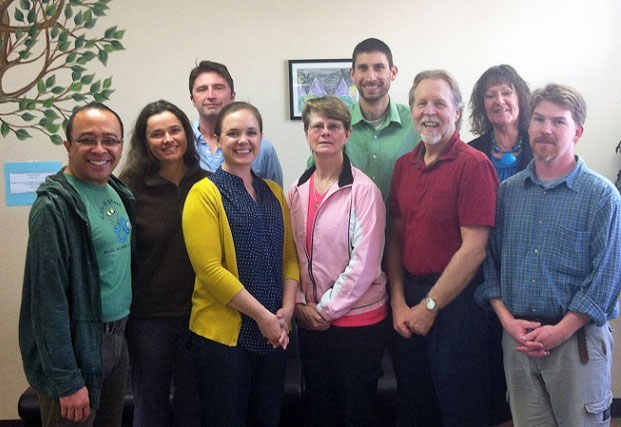
The practice has deep roots in the community. When it was founded by Dr. Thomas Wiard and Dr. Mary Vader three decades ago, they were known to take chickens for payment, if that’s what patients had to give.
The Western Slope of Colorado offers unparalleled natural beauty and a range of outdoor recreation, including world class fly fishing, hiking, skiing, and kayaking. Surrounded by national forests and national recreation areas in all directions, including Gunnison National Park, the Uncompahgre National Forest, and the San Juan National Forest, it makes for a dramatic landscape and a wealth of opportunity for adventure.
“Some of our doctors ice climb, and others love hiking. We are all very thankful that we live here and can enjoy the outdoors,” says Tubbs. “They’re all really fit and into outdoor activities.”
The region’s close-knit communities also make for great places to raise a family. This combination of attributes – family-friendly and recreation access – are selling points they use during the hiring process, as Pediatric Associates isn’t immune to the challenges of recruiting physicians to practice in rural locations.
And with a high percentage of the population on Medicaid, Pediatric Associates has taken an approach to physician compensation that differs from some other pediatric practices: “They get paid at a set salary, all of them, the same boat,” Hickert says.
By eliminating that reimbursement variable for individual physicians, they are freed up to see any and all patients without it affecting their ability to support themselves and their families. Hickert says the structure has been a positive for their practice.
“Here we are, almost 50 people strong, with support staff, two locations and all of our providers, and we’re making it work,” she says.
As a result of this unique combination of lifestyle and compensation, the group of providers Pediatric Associates has attracted share an underlying understanding of the value of family and community connection.
“It’s brought a really good group of doctors here,” says Tubbs. “They’re super, super kind. And they all have a heart for kids.”
Dr. Gregory Suchon, managing partner for Pediatric Associates, says the opportunity to use his skills to bring “quality pediatric care to an often forgotten and underserved population” is a privilege.
“Our small practice of fellow pediatricians and providers have managed to forge a particularly bold and progressive path that makes me incredibly proud,” he says. “I have found a similarly devoted group of medical professionals here in our small corner of the state, and a broader community that places great value on helping and supporting their neighbors. I couldn’t think of a more rewarding and fulfilling place to work, live, and raise my family.”
Next up for Pediatric Associates is tackling some of the challenges they see in the teen population they treat.
“We have a high pregnancy rate here for younger girls, unfortunately,” says Tubbs.
A teen center now in the planning phase is envisioned as a space where young women can go to see providers who are specifically tuned in to their needs. They’re looking at renting a space in a building close to the current office one day per week to start, says Tubbs.
“We have certain female providers that love to see the teen population,” she says. “They’re really good with those girls.”
The goal is to offer well-checks and a friendly, knowledgeable healthcare provider to talk to about birth control, menstruation or any other issues they want to discuss. It would also open avenues for depression screenings and other important health check-ins.
“What we’ve found is that the teens don’t like to come into the pediatric office because it is the ‘baby doctor,’” says Tubbs. “But they should be coming to us. They’re still kids. We’ve always had a dream of having a separate place for them to make it teen friendly.”
“We understand the value of working hard, seeing patients, and knowing what we have to do to survive in today’s market.”Amber Hickert, Pediatric Associates Practice Manager
A telehealth initiative with Children’s Hospital Colorado is also in the works. A dedicated patient room with equipment that allows the physician in Denver to see and hear everything that the onsite provider does will make specialty care more accessible to families in the communities they serve.
Instead of a drive over the mountains, or waiting months for an appointment at a specialty outreach clinic, children will be able to go to their local pediatrician for that specialty care. And the plan is to make this technology available not only to their patients, but to any family in the region who needs access to a specialist.
“It gives Children’s Hospital Colorado another level to providing access to services without leaving the Eastern Slope,” says Hickert.
Even as they continue to partner with institutions in their region, Pediatric Associates is also committed to remaining independent. This comes with a certain level of risk, but one that they’re willing to bear for the benefits it offers.
“I can honestly say in some respects it would be great to know you have the backing of something bigger,” says Tubbs, “but at the same time you lose the autonomy that we have and the ability to make these great improvements and decisions on doing a teen center or having telehealth. No one’s telling us we can’t do it.”
The group is ready to tackle the challenge 21st century healthcare brings, says Hickert, in part because the entire team has the best interests of the families they serve at heart.
“We understand the value of working hard, seeing patients, and knowing what we have to do to survive in today’s market,” she says.
[1] “2012-2016 American Community Survey 5-Year Estimates: Montrose County, Delta County,” U.S. Census Bureau, https://factfinder.census.gov/faces/nav/jsf/pages/community_facts.xhtml?src=bkmk ↑
[2] “2012-2016 American Community Survey 5-Year Estimates: Montrose County, Delta County,” U.S. Census Bureau, https://factfinder.census.gov/faces/tableservices/jsf/pages/productview.xhtml?src=CF ↑
A resident of Burlington, Vermont, Erin Post has a B.A. degree in English from Hamilton College, and is a graduate of the writing program at the Salt Institute for Documentary Studies. She is currently working on her master’s in public health at the University of Vermont. In her spare time, she likes to bike, ski, hike, and generally enjoy the Green Mountains of Vermont.
Pediatric care is complex enough — navigating for the future shouldn’t be a solo journey. Join host Chip Hart and learn from pediatricians, industry leaders, and policymakers who are shaping the future of pediatric care. Every episode, we explore their stories, their dreams, and the joy they find in medicine. Together, we’re charting the future of children’s healthcare.

The Independent Pediatrician is brought to you by PCC, which provides tools and services to help pediatricians remain independent and in control of their practices.
PCC itself is a fiercely independent business. As a Benefit Corporation, it puts the interests of its clients, community, and employees on an equal footing with those of its shareholders.


 Proust Questionnaire: Russell C. Libby, MD, FAAP