Going the Distance: Dr. Seth Kaplan on His Cancer Diagnosis Journey
TLC PediatricsFrisco, TX



As physicians, it is inevitable that you will have to deliver some kind of bad news to patients over the course of your career. It just goes with the territory. The American Medical Association has guidelines on how to deliver that bad news— crucially, the importance of planning for potential bad news and bracing oneself and one’s patients for the possibility that there may be a troubling diagnosis. But what happens when the person receiving the bad news is the doctor himself? This is the story of Dr. Seth Kaplan, an independent pediatrician whose sudden cancer diagnosis forced him to finally hear some messages his body had been sending him for a long time.
Dr. Seth Kaplan has been a long-distance runner since his early 40s. He was looking forward to getting back to running in public events with his running group after Covid restrictions were lifted. Due to his reduced training schedule, he anticipated that this race would not reflect his personal best. However, when his group entered the Dallas Half Marathon in December of 2021, his performance was not what he expected. As he ran, he found that he was short of breath and could not keep up with his running companions of 10 years. He ended up finishing 25 minutes slower than what he expected, a full 40 minutes slower than his personal best. He knew something was wrong, but he could not put his finger on what it was.
Kaplan mentioned his reduced endurance and capacity for exercise to his doctor during his annual physical. Although routine bloodwork revealed an elevated non-specific inflammatory marker, at first his provider seemed unconcerned. In fact, this inflammatory marker had shown improvement since his last test, which occurred during a thyroid issue that had since resolved. Still, just to be safe, he was told to have a coronary calcium scan — a test that creates images of coronary arteries to show existing calcium deposits and determine a patient’s risk for serious cardiac events.
As it so often happens with busy people, Dr. Kaplan did not immediately go to have the coronary scan. “I thought I was just having temporary exercise intolerance since everything else seemed ok,” Kaplan stated. As the month of December progressed, so did his respiratory decline. “At first, I thought it might be Covid, but I tested negative 11 times over the course of a month. Then we traveled to Arizona for a wedding, and I was coughing all the time and really short of breath. By then, I knew there was a real problem, but I still thought it might be Covid-related, like I had Covid without knowing it, and it had caused lasting heart damage.”
Kaplan reached out again to his GP to let him know what was going on, then decided to go ahead and have the heart scan. However, when he called to schedule it, there was a problem. The order for the heart scan had been lost. Another layer of complication was added because Kaplan’s provider did not use electronic health records. Much to Kaplan’s dismay, previously performed blood test results had gone missing, and would have to be repeated. By this time, Kaplan’s health was rapidly deteriorating. Forget about running—he could barely walk without getting winded. By the time everything was in place to carry out the coronary cardiac scan, Kaplan was having trouble navigating from his car to his office and was struggling to get through a ten-minute appointment with a patient. Finally, by mid-February, the heart scan was complete. The good news was that Kaplan’s heart appeared healthy, but the bad news started a cascade of events that would change Kaplan’s life forever.
“He sat me down and said, ‘I have to be honest with you. I don’t know how you are standing on two feet right now.'”Dr. Kaplan on his conversation with the radiologist
The heart scan revealed that Kaplan had an enormous mass in his chest. During our interview, Kaplan struggled to keep his emotions in check as he recalled the day he received the news and the days after when there were so many questions. It was clear the situation was dire—Kaplan was sent to follow up with an oncologist the very next day. The oncologist, who came in on her day off to consult with Kaplan, said that she would need to do more testing to identify what was causing the mass. “They got me a CT scan that morning. The oncologist gave me three potential causes for the mass: thymoma, lymphoma or primary lung cancer. Of course I was shocked. I have never smoked a day in my life.”
Kaplan had the CT scan at a hospital where he had seen and treated babies for 20 years. Although he was no longer seeing babies at that hospital, the radiologist knew him and called him into the reading room after the procedure. “He sat me down and said, ‘I have to be honest with you. I don’t know how you are standing on two feet right now.’” The growth had the volume of a grapefruit and had tentacles out that completely surrounded Kaplan’s aorta, one of his carotid arteries, and several other significant blood vessels. “Apparently, my being a runner was both a blessing and a curse. My cardio fitness level helped me get through the initial stages of my disease, but it also made my body able to tolerate much more before I finally shut down, leading to a more advanced condition.”
Kaplan had a port placed and had a biopsy taken of the growth. Then the waiting game began. Of the three potential cancers, thymoma and primary lung cancer had a significantly worse prognosis than lymphoma, and the aggressive appearance on CT made it look most like a thymoma. “They told me that if it was that form of cancer, there was nothing they could really do. I went to see a cardiothoracic surgeon who looked at it and told me, ‘This is so bad. I wouldn’t let anybody in Dallas touch you.’ He wanted to send me down to a doctor at MD Anderson in Houston who he said “might be able to shrink it,’ but it was pretty obvious to me that he was saying [shrinking] it wouldn’t be possible.”
“It was one of those icy days in Dallas when you don’t want to be on the roads,” explained Kaplan. “The cardiothoracic surgeon was so gracious and kind to meet with us with the weather being what it was. I walked out of that appointment thinking this could easily be the end for me. My wife and I began discussing next steps for getting my affairs in order. We were driving home from the appointment in a pretty somber state. Suddenly, we get a call from the general oncologist. When I answer, she starts screaming, ‘You’re CD 20 positive!’ I told her I should know what that means, but I didn’t. She said, ‘It means it is lymphoma and we can treat this with chemo, and you’re going to be just fine.’”
Kaplan went from considering the worst to finding out his cancer was highly treatable in hours. “I had all the emotions in one day,” he recalled. “When I thought I was dying, it sounded like I had very little time left. At that point, I did not really have the emotional space to think about what would happen to my practice. When I found out I would be ok, I had to consider how I would be able to take care of myself, my patients, and my practice while undergoing chemo.”
His diagnosis story did not end there. Genetic testing was done, and fortunately Kaplan did not have the genetic markers that would limit treatment options. “It [the cancer] was so widespread that it was already stage 4, but because of the type of lymphoma it was, there was a 75% chance that a single course of chemo would take care of it, which is what ended up happening.”
Dr. Kaplan (left) with supporters at the 2023 NYC Half Marathon.
“I had all the emotions in one day,” Kaplan recalled. “When I thought I was dying, it sounded like I had very little time left. At that point, I did not really have the emotional space to think about what would happen to my practice. When I found out I would be ok, I had to consider how I would be able to take care of myself, my patients, and my practice while undergoing chemo.”
With at least one round of chemo looming ahead, Kaplan had to figure out how he was going to keep up with patients while taking the time to heal himself. “It was about three weeks between getting biopsies and testing to starting chemo, and I was seeing patients that whole time, but only about a quarter of the number I was seeing before. This was also during a busy time at the practice due to the Omicron variant of Covid taking hold. I probably should not have been in the office since my immune system was garbage at this point,” Kaplan explained.
Kaplan’s cancer treatment caused some unanticipated complications. “My oncologist gave me what they call ‘continuous chemo’ where they give you a pump on Monday and you wear it all week until Friday. You had to go in each day and have the bag replaced and have everything flushed out,” Kaplan explained. He was told by his doctor that the chemo would be in a “tiny little fanny pack, nothing obtrusive.” Of course, nothing is as easy as we think. “I went to pick it up, and this thing was huge. It was the size of my Scooby Doo lunch box back in the day. Also, it made little buzzing noises every fifteen seconds. There was no way that thing would work in a pediatrics office. Kids are curious and they would want to touch it; plus, I would not be able to fit PPE over the thing. At that point, I knew there was just no way I could work and go into the office.”
“When we were planning out my treatment, my oncologist said I would start feeling significantly better quickly due to the large amount of steroids I would be taking which would be able to reverse a lot of the damage to my lungs. Once I was not coughing and short of breath all the time, I would be able to work, as long as I was not actually in the office with sick kids,” said Kaplan. His chemo sessions occurred on a three-week cycle: week one he received chemotherapy and steroids, week two he would work to recover from the therapies, and week three was generally a “feel good” week where he could see patients via telemedicine appointments. “I was able to hold out this way until the last couple of cycles when the treatments got harder on my body,” stated Kaplan. “After a while it was hard to get through even a remote workday.”
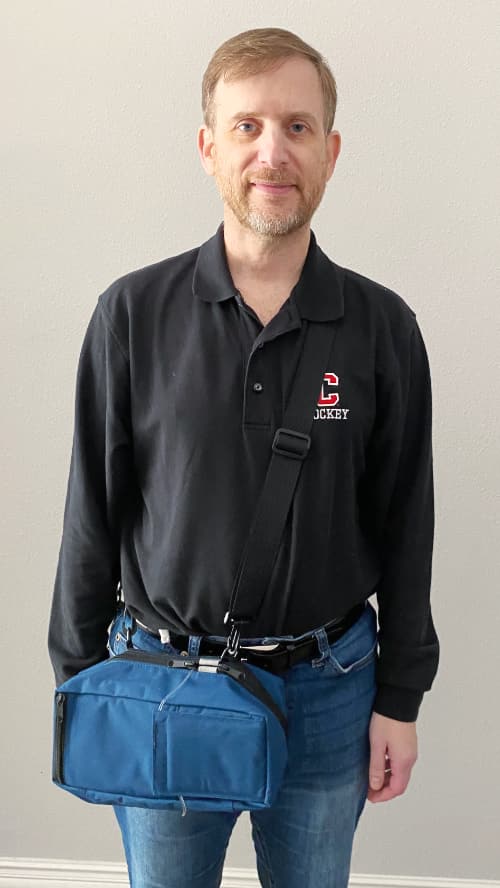
According to Kaplan, “At that point, I realized that I needed to spend the time to take care of myself. That message has been sent to me in many forms over the years, but this time it was the ultimate ‘in your face,’ and there was no ignoring it.” Kaplan knew his practice would take a financial hit, but there was no way around it—he had to step away for awhile, as much as he could. “It became obvious—if there is no me, there is no practice.”
The message of self-care was finally sinking in, to the point where Kaplan felt he needed to stress its importance to other physicians. “I saw a comment thread on the American Academy of Pediatrics (AAP) Administration and Practice Management Listserv where people were upset about Covid restrictions because they could not afford to take a day off for illness. I responded with a long diatribe entitled, ‘You Can’t Do Telemedicine if You’re Dead,’ which seemed to resonate with people because I got many positive comments. We forget this because we devote ourselves so completely to the care of our patients. However, the truth is if we don’t take care of ourselves, we can’t take care of anyone else.”
Through sheer happenstance, Kaplan was able to put together a team to handle things in the office while he was recovering. “I had a former colleague who was looking for a place to work while he was building a new practice, and another provider I knew through advocacy work who was in search of a part-time position. Both of these circumstances kind of fell into my lap right when I needed them.”
After responding well to chemotherapy, Kaplan consulted a physician who specializes in Kaplan’s particular form of cancer. Even though his tests showed some residual disease, the specialist told him to hold off on any further treatment like radiation. “He [the specialist] told me this will be gone in six months, and everything would be ok. Six months out is where we are right now, and everything has been improving. It seems I am on the other side of this, and that is a great place to be.”
“What is really important is to spend some time each day doing something that is meaningful to you. It can be anything—reading, running, spending time with loved ones. For me—one of those meaningful things is advocacy work. I have always been involved with advocacy work in the past, but I had to slow down due to my illness. I am looking forward to getting back to it.”Dr. Kaplan
Running as a hobby is about resiliency and overcoming obstacles. Distance running requires stamina, endurance, and determination. All these characteristics of a runner were called into play for Kaplan during his cancer diagnosis and treatment journey. Kaplan is now using his experience with chronic illness to help other independent pediatricians engage in better self-care and plan for potential practice obstacles such as a chronic disease diagnosis. He is preparing a series of talks and writing a book about his diagnosis and ways physicians can prepare for personal health crises such as obtaining proper insurance coverage and succession planning. “We need to have the discussion about what independent pediatricians need to do so their practices will survive through a crisis like this,” Kaplan explained.
“As physicians, we rely on the good graces of our own health to do the work we do. When health problems come up, we tend to catastrophize them because we know the worst-case scenario. For example, if you have a cold that lasts too long, you might think, ‘Wait, what if it’s cancer?’ That thought crossed my mind many times, and I always found out I was ok, until I wasn’t. I can’t speak for everyone, but I think most physicians are not prepared for the day that the worst-case scenario is what is really happening.”
Kaplan also plans to discuss some of the personal lessons he learned from this experience in his future presentations. “Due to our busy schedules, often independent practitioners do not spend our free time as mindfully as we can. We need to be more intentional with our time and our priorities. For example, it is crucial to invest in your relationships—don’t neglect them. Take the time to care for your family, because they are the ones who will be there to pick you up when you need it.”
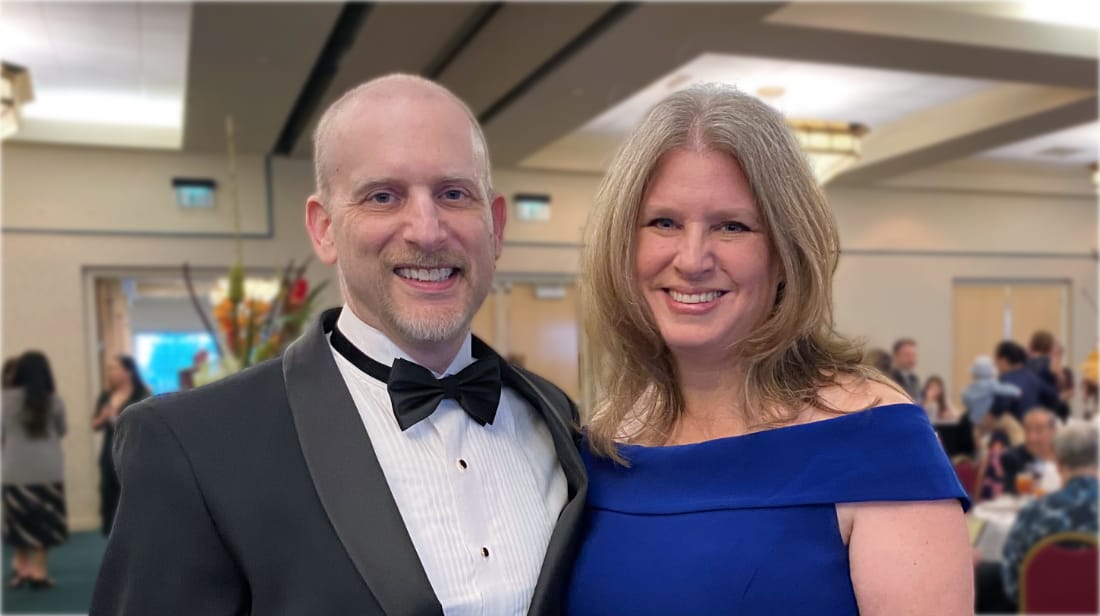
Dr. Kaplan with his wife at the Texas Pediatric Society Foundation Gala, shortly after completing his treatment.
Kaplan also strongly recommends therapeutic measures such as yoga, meditation, or even writing about your experiences while processing a catastrophic diagnosis. “Since this health crisis, mediation has become part of my daily existence. It’s a tremendous way to deal with anxiety and focus on living in the moment. Meditating every day has made my practice more efficient by enabling me to concentrate on what is in front of me rather than having my mind speed to the next thing.”
Meditating is just one of the self-care measures Kaplan recommends. “What is really important is to spend some time each day doing something that is meaningful to you. It can be anything—reading, running, spending time with loved ones. For me—one of those meaningful things is advocacy work. I have always been involved with advocacy work in the past, but I had to slow down due to my illness. I am looking forward to getting back to it.”
Kaplan says he has learned a lot about the importance of kindness to others, but especially to oneself. “My diagnosis happened at a time when people were starting to be fed up with Covid restrictions. There was a lot of anger and frustration out there. Through my experience it became very clear that responding with kindness in all situations is essential to reduce the stress in the environment. Kindness takes the temperature down and makes everything easier.”
As for being kind to oneself, Kaplan explains, “In our positions [as independent pediatricians], we are often our own worst critics. We beat ourselves up for little mistakes. I think that as long as we aim to do what is good and right, we should give ourselves grace when we misstep, as long as we acknowledge it and learn from it. If we are not kind to ourselves, we run the risk of getting chronically down and losing the joy in what we do—and that leads to existing instead of really living.”
Kaplan has now come full circle and recently completed the 2023 NYC Half Marathon. In addition, he had a completely clear PET scan for the first time in April, meaning his cancer is fully in remission.
Dr Kaplan will be presenting at the 2023 PCC Users Conference on Wednesday July 12th, including concrete steps to help prepare one’s practice for addressing such a disaster. More information about the UC can be found at https://www.pcc.com/uc-2023/.
Allyson Howard is a firm believer that well-crafted stories can redefine brands and organizations, reinvigorate internal and external business communications, and engage and inform consumers in groundbreaking ways. Her BA in English and Education from the University of Iowa, as well as her MS in Professional Writing from NYU, have positioned her to create a wide range of content tailored to communicate unique brand voices and messages. She lives outside Chicago with her family and enjoys cooking for loved ones and reading.
Pediatric care is complex enough — navigating for the future shouldn’t be a solo journey. Join host Chip Hart and learn from pediatricians, industry leaders, and policymakers who are shaping the future of pediatric care. Every episode, we explore their stories, their dreams, and the joy they find in medicine. Together, we’re charting the future of children’s healthcare.

The Independent Pediatrician is brought to you by PCC, which provides tools and services to help pediatricians remain independent and in control of their practices.
PCC itself is a fiercely independent business. As a Benefit Corporation, it puts the interests of its clients, community, and employees on an equal footing with those of its shareholders.


 An Essential Space for Women in Pediatrics