Sailing Your Own Ship: Dr. Caroline Morgan on Thriving in Independent Practice

Pirate PediatricsGreenville, NC

Dr. Morgan founded Pirate Pediatrics in Greenville, NC to chart her own course, and with hard work built a tight community. Then an unexpected illness forced her to reconsider her views on teamwork, self-reliance, and boundaries.

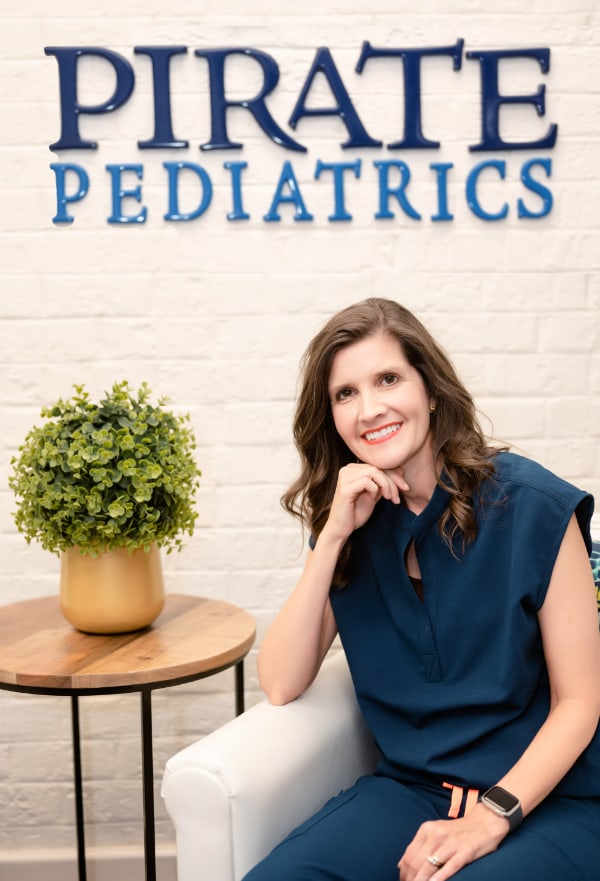
Dr. Caroline Morgan of Pirate Pediatrics

Sailing Your Own Ship: Dr. Caroline Morgan on Thriving in Independent Practice

Pirate PediatricsGreenville, NC

Dr. Morgan founded Pirate Pediatrics in Greenville, NC to chart her own course, and with hard work built a tight community. Then an unexpected illness forced her to reconsider her views on teamwork, self-reliance, and boundaries.

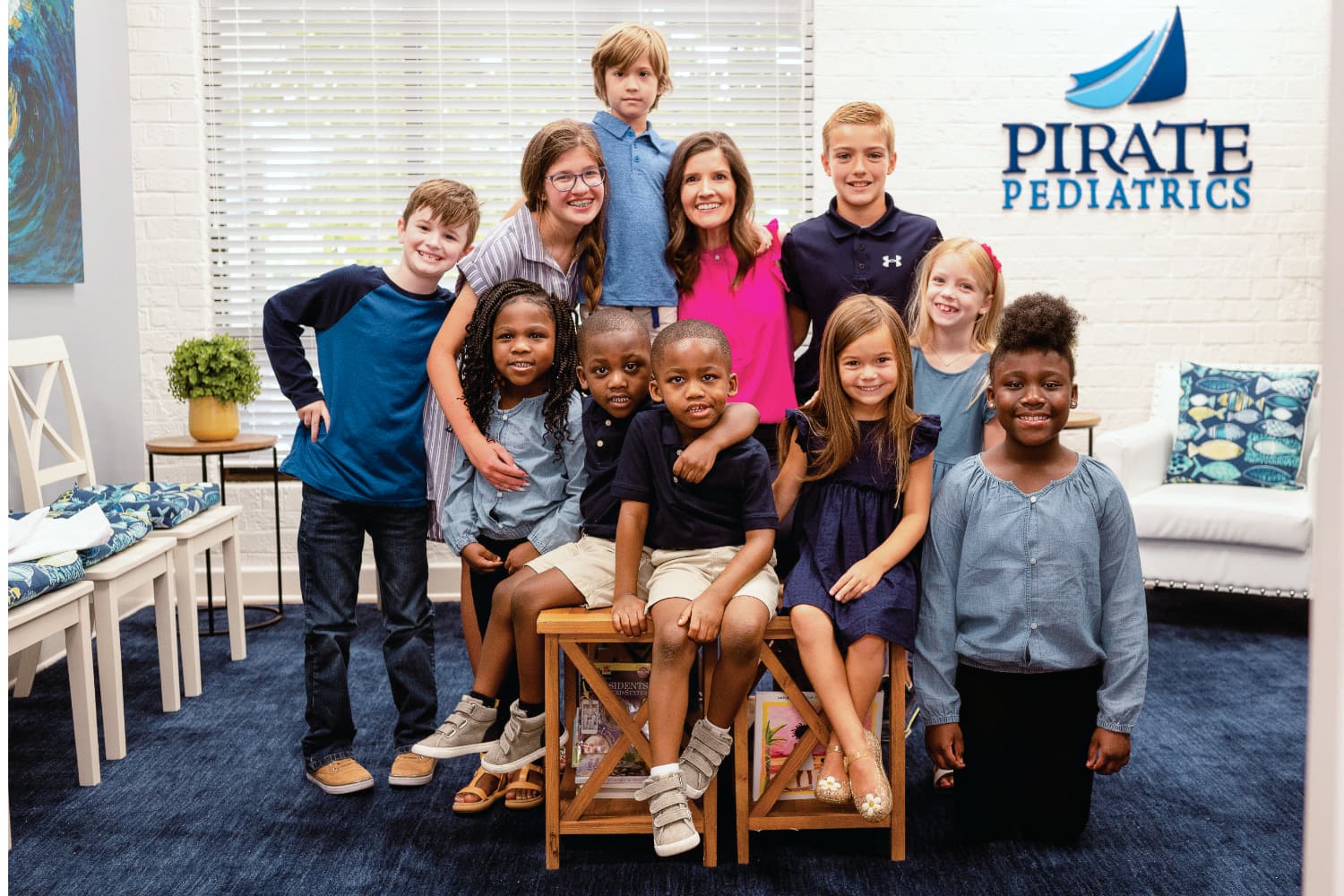
When you walk into Pirate Pediatrics, you know it’s a different kind of pediatrician’s office. The soothing blue-and-white decor is welcoming and warm, with comfortable furniture and nautical-themed imagery that puts visitors at ease. Every photo on the wall is a patient. There’s even a playground and a sensory room.

Continuing with the pirate ship theme, the practice divides its exam rooms into “port” and “starboard” — sick visits on port and well-child and non-sick visits on starboard.

When you enter the halls, you’re greeted by one of the most special things about the practice: the newborn footprint tiles that adorn the walls. There are over two thousand tiled all along the hallways of the practice, in a rainbow of colors, each representing a patient and family welcomed into Pirate Pediatrics.

Dr. Caroline Morgan, owner and founder of Pirate Pediatrics, began creating the newborn footprint tiles during an infant’s first visit to the office, highlighting the practice’s commitment to continuity, care, and community.

“Connection is at the heart of what we do here.,” she explains. ” I want Pirate Pediatrics to be a welcoming and supportive space in the midst of troubles and trials as well as the good times.”

Even the pirate theme comes from Dr. Morgan’s dedication to the surrounding community. The practice is located in Greenville, North Carolina, home of the East Carolina University Pirates.

“I wanted this office to feel part of the community. If you live here in Greenville, you’re a Pirate.”

The atmosphere is nautical but friendly: no frightening images of fights or pirate attacks, just friendly seafaring fun. It’s a place for kids, first and foremost.

Dr. Caroline Morgan of Pirate Pediatrics
Connection is at the heart of what we do here. I want Pirate Pediatrics to be a welcoming and supportive space in the midst of troubles and trials as well as the good times.

Dr. Caroline Morgan

Dr. Morgan’s Story

Dr. Morgan always knew she wanted to work with children. Before she was a doctor, she was a high school science teacher. She taught biology and chemistry and was preparing to start teaching physics when she and her husband moved to North Carolina, her home state.

She took the opportunity to “give medical school a go.” She’d wanted to be either a doctor or a teacher when she grew up, and she’d been a teacher. Now, she was ready to try the doctor’s route.

“We pulled up in the U-Haul truck, and my husband unloaded the truck, and I went to a class to learn and study for the MCAT,” Dr. Morgan reminisces. She tutored students preparing for med school before beginning her own medical education.

When it came to choosing her speciality, she reflects “I always knew it would be kids, but when I did my third-year rotations, lo and behold, I was assigned to pediatrics last. So I thought, ‘Well, I’ll immerse myself in each specialty, and see if I could picture myself doing it.'”

She recalls loving obstetrics, believing she had finally found her place, but she discovered a hint of her true fit when after births, she had to be coaxed into pulling her focus from the newborns. When she finally made it to her pediatric rotation, she knew she was in the right place.

“I want to know who they are, without needing the chart in front of me,” she says. “I care about what they enjoy and that they went to Disney World. I want to be able to talk about it when they return, to genuinely know and remember them, and to build that connection.”

Dr. Caroline Morgan

Finding Her Fit

Dr. Morgan initially considered pursuing a subspecialty, and spent a month rotating in hematology-oncology at St. Jude Children’s Research Hospital in Memphis, Tennessee. While she felt a strong connection to the children and families she cared for, she quickly realized that a subspecialty wasn’t the right fit her. Her interactions with patients were brief, emotionally heavy, leaving her longing for a deeper connection with patients and her community.

“I wanted to learn enough about subspecialties to guide and support families, but I wanted a more positive, uplifting environment where I could watch kids grow and develop over time. That’s how I knew general pediatrics was where I belonged.”

Getting to know patients has always been a priority for Dr. Morgan.

“I want to know who they are, without needing the chart in front of me,” she says. “I care about what they enjoy and that they went to Disney World. I want to be able to talk about it when they return, to genuinely know and remember them, and to build that connection.”

After working in a couple of healthcare settings that weren’t the right fit, Dr. Morgan decided to open her own. She wanted to be free to make her own choices, cultivate the culture that had led her to practice medicine in the first place. She stepped away from group practice and took time to prepare. In January 2012, Pirate Pediatrics welcomed its first patient.

“I said, ‘Tell me any concerns you have, because I do not want you sitting at home stewing and carrying the burden of misinformation, thinking you’re doing something that’s going to harm your child.’ We talked through that, and the baby got her life-saving vaccines. She got all of them.”

Dr. Caroline Morgan

Building a Practice: Growth and Intentionality

No one does it alone, and Dr. Morgan is no exception. She works closely with her husband, Nathan, who supports her in running Pirate Pediatrics. Along with her dedicated team, known as the Pirate Crew, Dr. Morgan has built a strong network of support that has been with her through the journey.

But at the end of the day, Dr. Morgan captains her own ship. While many of her colleagues bring on business partners, she prefers to stay solo at the helm. While she doesn’t mind having support or input, she reflects that final decision-making is something she prefers to keep.

“I hear doctors say they have to consult their partners on many decisions, from choosing an EHR to selecting wall colors. I really want to be able to have the flexibility to make those decisions quickly and efficiently.”

Today, more than 12 years after starting Pirate Pediatrics, Dr. Morgan still steers her own ship.

Needs-First Practice Design

Dr. Morgan has designed her practice based on what she sees around her. New parent care is a major need among the families she serves, especially with the rise of misinformation from social media. She recently sat with a mother and talked through her worries about vaccinations.

“I said, ‘Tell me any concerns you have, because I do not want you sitting at home stewing and carrying the burden of misinformation, thinking you’re doing something that’s going to harm your child.’ We talked through that, and the baby got her life-saving vaccines. She got all of them.”

Dr. Morgan has also noticed the growing need for mental health services. She employs licensed clinical social workers (LCSWs) and collaborates with Duke University experts. She hopes to expand Pirate Pediatrics’ mental health services to continue to meet the needs of the families they serve.

Life at Pirate Pediatrics

Community connection and care form the foundation of the workplace culture at Pirate Pediatrics. The practice’s website proudly displays Dr. Morgan’s five core values for her team: flexibility, integrity, team orientated, solution seeking, and support.

Those values aren’t just buzzwords for Dr. Morgan or her team. She loves asking team members where they’ve seen others live the office’s mission and values.

If you visit Pirate Pediatrics, you might spot a brass seahorse named Sammy FITSSeahouse, named for the acronym of the practice’s five core values. Sammy serves as a special trophy awarded to team members who go above and beyond. Dr. Morgan and her staff members pass him around to celebrate exceptional work and to recognize a job well done.

Commitment is important to Dr. Morgan, but so is the personal well-being of her staff, including herself and her family. Pirate Pediatrics is closed on Saturdays and Sundays, a perk that she explains is rare in U.S. primary care.

“I want my staff to have time with their families, to be well-rested and to enjoy their work when they return  on Monday,” she says. Providers are available for telehealth during off-hours, but they aren’t required to come into the office.

Weekends off are part of Dr. Morgan’s commitment to work-life balance, something she learned the importance of in 2017 through a lesson that almost cost her her life.

The Danger of Overwork

Five years had passed since Pirate Pediatrics opened its doors, and Dr. Morgan was pulling triple duty. She was the CEO of the business; she was working full time as a clinician. She was a mother to a young daughter. While her team were fully on board, Dr. Morgan was the heart and soul of the practice. No matter what she herself was feeling – which was not very well, in the midst of sick season – she had to show up to make sure patients and families were being served.

So she did. Until she could not.

A twofold blow of pneumonia and flu hit Dr. Morgan with such severity that she was forced to transition from doctor to patient. Even then, it was difficult. Her patients needed her.

It was soon clear, however, that even if she wanted to, Caroline Morgan could not heed the call of families as she always had. The infection had entered her bloodstream. Worse, she was in preterm labor with her second child, and her medical team needed to intubate if they were to save both Caroline and the baby.

Pirate Pediatrics’ nurse practitioner called Dr. Morgan’s husband, Nathan, who was on a trip to the Grand Canyon. He flew back across the country to Raleigh and drove an hour and a half to the hospital, where the pulmonary critical care doctor and obstetrician laid out the sobering facts: both his wife and child were in danger, and it was unclear whether they would survive the night.

The team couldn’t get the ventilator settings under control, and they were worried about the baby’s heart rate. If his heart rate dropped, they would have to do a cesarean section in the intensive care unit, and Caroline’s body was not strong enough to survive the procedure.

“I wasn’t breathing,” she recalls, matter-of-fact and calm in her retelling. “They didn’t think I was going to make it to the next morning. [Nathan] fell down in the hall and cried. He said, ‘Dear God, I cannot do this business by myself. I cannot raise my daughter by myself.’ They would save the baby over me, so then he would have a NICU preemie baby to take care of. He said, ‘I could not.'”

The team wasn’t optimistic. They’d never intubated a pregnant patient who survived. They’d never had the developing baby not crash in such a situation. The crash cart would have to be present, and they could not seem to locate one fast enough.

The next morning, Dr. Morgan woke up, still pregnant, still very ill, but still alive and even briefly conscious.

“The nurse ran from my bedside and said, ‘Oh my God, she’s awake.’ And I remember thinking, ‘Am I not supposed to be? I thought you were just resting my lungs, right?’”

When she was strong enough, her team told her how close she had been to dying. She learned that a pediatric anesthesiologist and an obstetrician had spent the night at the hospital certain they’d have to do a C-section. She also found out that she was the first pregnant patient they’d intubated whose baby didn’t crash. She and her son had made hospital history.
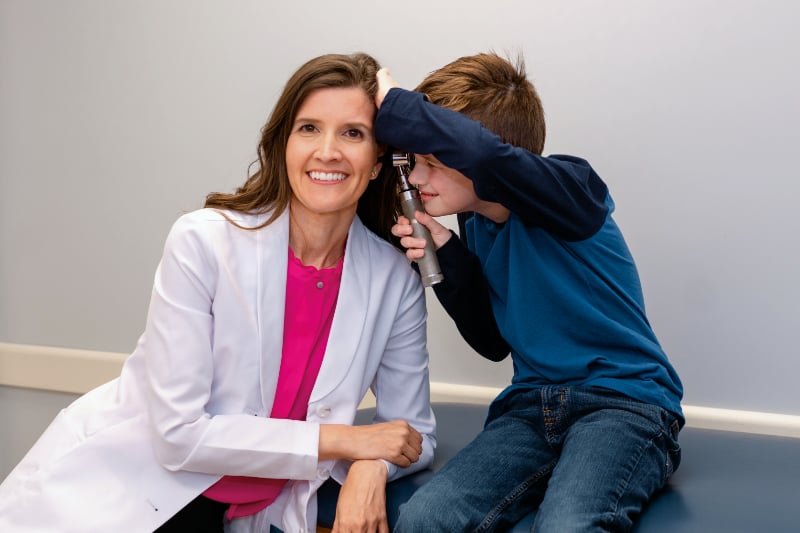
Dr. Caroline Morgan of Pirate Pediatrics

“The Ears Work”

Even when she was unconscious and fighting for her life, Dr. Morgan was still learning about the patient experience in an entirely new light.

“I was out,” she says, “But I remember an argument right at my feet. The OB was trying to give me more magnesium to stop the contractions. The critical care doctor said, ‘That’s what’s causing her lungs to fill up with fluid, and I can’t regulate her breathing if we keep giving more.’ OB said, ‘Well, can we give just one more dose of magnesium and follow it with Lasix, a diuretic, which would help the fluid come out?'”

Seven years later, the memory of witnessing the argument still upsets her. As a patient, how was she supposed to feel safe and supported with her care team literally squabbling around her bedside? Now, she tells everyone who will listen: hearing is the last thing to go, even if a patient seems unconscious.

“I’m living to tell you that the ears work,” she emphasizes. “If [they] can hear, they are hearing what you’re saying.” She knows that many patients, like herself, find conflict upsetting. She urges providers to rethink what they say around unconscious patients, in case they hear something that impedes their recovery.

“I’m Not Going to Work Like That Again”

When she woke up in the hospital, Dr. Morgan didn’t even have the energy to open her eyes. She couldn’t speak above a whisper, but she managed to ask why her eyes wouldn’t open.

“They said, ‘You don’t have enough energy to. All your energy is being used to heal your body.'”

At that moment, Dr. Morgan vowed never to  push herself to such extremes again. She prioritized her health and recovery, spending four challenging months regaining enough strength to return to work just one day per week. While she has gradually increased her workload, she has intentionally not returned to her previous intensity since the health scare.

Babies sometimes have uncanny timing. She recalls with a smile how her water broke not long after returning home, and back to the hospital they went.

Despite her grave illness, her body’s tenuous recovery, and the fears for her life and her child’s, her son was born healthy and strong — still premature but not in need of neonatal ICU care. With a wondering smile, Dr. Morgan says it was as though he hadn’t been affected at all by the experience. He is now seven.

Achieving Balance in Practice

When Dr. Morgan returned to work, she was shocked to learn that while she was fighting for her life, some patients kept demanding her attention. Boundaries? They didn’t exist, because she had not drawn them for herself or for the practice.

“When I was intubated in the ICU, having a machine breathe for me, there were people calling and demanding to see me. You can be dying in the hospital and people still want you to do for them. And I had to learn, where is that line?”

The experience taught her a difficult lesson: when you help others for a living, you need to set your own limits.

A crucial part of setting limits has been staying true to her values as a physician and maintaining clarity in her practice’s vision, even when others may not fully align with it. Dr. Morgan acknowledges that, even in a place as intentionally caring as Pirate Pediatrics, there are times when expectations differ. “We have people that get disgruntled. Some families get frustrated that we don’t double or triple-book appointments or operate like an urgent care clinic,” she explains. “Our focus is on providing personalized, comprehensive care, which requires a different approach.”

As an independent physician, Dr. Morgan has the freedom to release families who want a different kind of practice. It’s not about picking and choosing, but sticking to her vision and being there for people who share her values.

“I had to accept I could not please everyone. Gaining that perspective allowed me to set boundaries. Seven years later, I’m still refining them, but I have firmly maintained the boundary of Saturdays and Sundays, because we all need rest.”

In 2019, Dr. Morgan received a Razzie Award from the American Academy of Pediatrics Section on Administration and Practice Management (SOAPM). She received the award for helping a mom with ADHD to apply for life insurance, despite pushback that it “wasn’t her job”. The award recognized her for going above and beyond — or, as the award said, “For parents who overreach.”

Dr. Morgan laughs, remembering the parent who demanded to see her while she was fighting for her life. “If only y’all knew,” she says.

Practice Leadership and Clinical Care

As CEO of a private practice, Dr. Morgan wears multiple hats. She’s a practicing clinician who is also in charge of the practice’s business aspects, including growth and marketing. They are two wholly different skillsets.

“It’s very difficult to switch from clinical to admin,” she admits. She manages her workload by scheduling days or blocks of time to focus on what she calls “visionary work”: the tasks that move the practice toward her vision for the future. On the other days, Dr. Morgan sees patients as a clinician.

She recently brought on an assistant, who serves as a scribe during appointments and handles various administrative tasks in the office. Hiring for the role has allowed Dr. Morgan to see more patients while providing even better care.

With an assistant helping with tasks like keeping notes and managing records, Dr. Morgan can dedicate more time to one-on-one patient care. The approach has been so effective that she’s hired a second assistant and plans to expand her team further.

Hiring for Vision and Mission

Dr. Morgan has built a committed team of 15 professionals, including office staff and clinical providers.

She has team members considering careers as physician’s assistants, nurses, and doctors. Their time at Pirate Pediatrics is part of their journey, and Dr. Morgan is proud of being able to help them grow, even if they don’t stay for long.

“I’d love to keep them, but what I truly enjoy is helping them achieve their dreams. And they make great employees.”

She shares the story of one applicant who decided to take a break from medical school. Despite knowing that the applicant would be with the practice for less than a year, Dr. Morgan invited her to interview as a scribe.

“It will help her build confidence, learn the language, and then when she returns to school, she’s going to be stellar. She’ll be even more prepared. She’ll either have a strong foundation or realize this isn’t the path she wants to take. And sometimes, that clarity is more valuable.”

Choosing Staff With Care

Dr. Morgan is careful and purposeful in whom she hires. She considers the person’s ability to do the job and their commitment to her mission and vision.

Her interview process is multi-layered. After a candidate sends an application, the team asks them to send a short video to gauge their communication style. If that goes well, the clinical or admin team leader conducts a phone interview, and after that comes a personality profile.

In-person interviews are the final step. Dr. Morgan sits in on clinical interviews but allows her team leaders to take the primary interviewing role. She listens to ensure clinical answers are correct and steps in when she wants to dig deeper.

“My role is the friendly interviewer. I aim to put them at ease and focus on keeping the atmosphere relaxed. While I might ask them a tougher question, it’s conversational and not interrogating.”

Dr. Morgan is proud of the feedback her team receives about their interviews. She appreciates that people find them conversational and enjoyable, even though the interviewees are there for two hours or more.

These steps have one overarching goal: to hire confidently and be sure the person is the best fit for the patients and team.

Mentoring Students and Residents

Although she’s left her days as a full-time teacher behind, Dr. Morgan still enjoys mentoring and talking with medical students and new doctors. She’s passionate about introducing them to the world of private independent pediatricians, which is very different from the academic institutions they work in as students and residents.

Working with students as an independent practitioner can be challenging. Her local university requires supervising physicians to be employees, so Dr. Morgan has found other ways of mentoring. She enjoys having medical students shadow her in her practice. One recent shadow said that the experience changed her career trajectory, and she’s now considering primary pediatrics.

“I’m hoping she’ll spread the word that private, outpatient, independent pediatrics is awesome,” Dr. Morgan says hopefully. She’s passionate about sharing the way she does things, in part because she doesn’t want new doctors to work themselves nearly to death as she did.

“I want people to see there’s not one way to do private, independent pediatrics. You don’t have to work yourself into the grave in order to be successful and to feel like you have a purpose.”

“My goal isn’t to be the biggest or to create a supergroup – that’s not my focus,” she emphasizes. “I’m focused on cultivating a strong culture and providing opportunities for our team and for the families we serve. If the demand for what we offer grows, then I’m open to expanding.”

Dr. Caroline Morgan

Looking Toward the Future

Dr. Morgan is committed to meeting the needs of local families for as long as she can. Her primary goal for Pirate Pediatrics is to provide the best possible care within a healthy and thriving practice.

“My goal isn’t to be the biggest or to create a supergroup – that’s not my focus,” she emphasizes. “I’m focused on cultivating a strong culture and providing opportunities for our team and for the families we serve. If the demand for what we offer grows, then I’m open to expanding.”

Growth seems to be on the horizon for Dr. Morgan and her team. She’s already seeing the children of patients who joined the practice as teenagers when she opened. Now in their early twenties, they’re excited to bring their own kids to Pirate Pediatrics.

She’s looking into hiring additional medical and mental health care providers in addition to support staff. But the biggest news is that Pirate Pediatrics has purchased an additional building, right next door to their current office, which will help to further expand their services. Dr. Morgan sees it becoming a flexible space where she can offer more non-traditional services.

Non-traditional care is an essential aspect of Dr. Morgan’s vision. Pirate Pediatrics has a playground and sensory room, providing space for an applied behavioral analysis (ABA) group. The new building may offer more space for that group and other mental and behavioral health services.

“Prior to the COVID-19 pandemic, we hosted groups for kids with ADHD. I would love to bring those services back,” she reflects.

Dr. Morgan even has something special in store for her staff — a new staff lounge where they can relax and recharge. She’s fitting the new space with a full kitchen for staff use and possibly more. Wanting the community’s input on what happens, she regularly asks parents and staff for suggestions.

As for the far future, Dr. Morgan sees herself serving the community as long as the need exists. She hasn’t ruled out the possibility of selling the practice, but the fit would need to be perfect.

“I’m just keeping an open mind,” Dr. Morgan says. “Who knows what the future will bring?”

Building Bridges: Resources for Pediatricians and the Families They Serve

Dr. Morgan created Pirate Pediatrics because she had a vision for how she wanted to practice. She needed a way to realize that vision, and Pirate Pediatrics is the thriving result. Today, she has a message for pediatricians, students, or residents considering private practice: you can live your life and run a successful business harmoniously.

Harmony can seem a million miles away for physicians who feel overworked and alone: an all-too-common experience in pediatrics. In a 2022 American Medical Association (AMA) survey, 55% of pediatricians said they felt burned out, and 48% said they didn’t feel valued.

As burnout becomes more well-known and understood, some larger practices establish physician support committees and departments. The U.S. Department of Health and Human Services publishes resources for individuals and organizations to take care of each other.

Meanwhile, more professional associations are stepping up to the plate. If you’re a physician or student looking for resources on burnout and well-being, here are a few to get you started:

Resources also exist to make you feel less alone in serving your team and patients. Examples include:

  • BrightFutures: Parent resources from the American Academy of Pediatrics
  • The REACH Institute: Resources for advancing children’s mental health care
  • Pediatric Policy Council:  Pediatric advocacy opportunities through the American Pediatric Association
  • Lyra Health: A proven mental healthcare benefit to take care of your employees
  • Shots Heard: Tools for fighting vaccine misinformation and defending against anti-vaccination attacks
  • Physicians Computer Company: An integrated pediatric EHR solution that simplifies practice management so you can focus on caring for patients.

It’s important for all physicians, independent and otherwise, to remember that care takes energy. You can’t give patients the best possible care if you work yourself into the ground. To continue doing what you love, you need to honor your needs and use the available resources. Only then can you practice at your best.

During the interview at her practice in October 2024, Dr. Morgan leaned over the conference room table where her staff holds meetings, her brown eyes full of care and concern, as though to impress on providers who were not there that she wants to save them the pain she experienced due to overwork. “It does not have to be about seeing more patients, and being open 24/7. While that’s a common expectation, doctors also need to take care of themselves and their families. It’s possible to have harmony between the two, and I want them to see that.”