Kids Plus Pediatrics: Using Innovative Thinking to Engage Patients, Support Community, and Grow a Dynamic Business
Kids Plus PediatricsPittsburgh, Pa.




Kids Plus Pediatrics (KPP) of Pittsburgh, Pennsylvania, is anything but your typical pediatric practice.
A recent visit to their Squirrel Hill, Pennsylvania, office showed us what is possible when you mix together business acumen, technical savvy, a healthy dose of dreaming big, and the synergy of minds who think outside the box. Where you land is a world without limits, where no idea is too grand, and where innovation is the name of the game. Complacent is not a word you would use to describe this practice. When you sit down with the folks at KPP, the excitement for what they are doing is palpable, it rubs off on you and you start thinking that you too can accomplish anything you can conjure up. And have loads of fun while doing it.
So how do they do it? What makes KPP not just a pediatric office, but a destination for families and community members alike? PCC sat down with Dr. Todd Wolynn, CEO of KPP and chief executive director of the Breastfeeding Center of Pittsburgh and Chad Hermann, communications director at KPP, to find out.
A big focus throughout our conversation is that fact that pediatricians must ask themselves: “How do we remain relevant in today’s culture of urgent care, and where today’s new parents are typically digital natives, millennials accustomed to living their lives online, who expect more from their pediatrician than just a quick visit and a prescription?”
Today’s pediatrician is being called to shed the old ways of doing things and listen to what their patients and families want… and the name of the game is engagement. When you engage your patients and their families in person at appointments and at events, when you engage online with your website and social media platforms, you strengthen patient satisfaction and build the loyalty that will keep you thriving as a viable, independent pediatrician.
“We form what we do around the idea of 24/7 and 365. We’re available in some form or variety of ways all the time… so a mom at 2 a.m. holding a feverish baby can read a doctor’s note on our website, feel calmer, and maybe avoid a trip to the ER.”Chad Hermann
Let’s dive in. First topic, availability. The first way you can stand out is to have more availability. This is the key to competing with urgent care clinics, as well as gratifying millenial parents. Hermann shared: “We’re open seven days and four nights: 61 hours a week. We hear literal gasps when we tell other offices that. But we’re still NOT open more than twice those hours, and urgent care centers are. So what do we do with and for patients while we’re open and while we’re not open? Patients can call in… we answer and return calls 24/7. But that’s still not enough. So, we form what we do around the idea of 24/7 and 365. We’re available in some form or variety of ways all the time… so a mom at 2 a.m. holding a feverish baby can read a doctor’s note on our website, feel calmer, and maybe avoid a trip to the ER.”
Dr. Wolynn and Hermann went on to discuss the evolution of urgent care centers, saying: “Adult care created urgent care, not pediatrics. At one point, urgent care had a smaller copay than seeing a primary care physician. Pediatricians got swept up in that whole movement. Pediatricians can usually get patients in the same day or the next day, so it [choosing urgent care over seeing the pediatrician] wasn’t about availability per se, it was about the ease of getting in.” Taking this into account when thinking about increasing their appointment availability, KPP recognized that millennial parents wanted the gratification of being able to walk in and have an appointment. Parents didn’t want to have to call and explain the reason why they wanted to come in, they just wanted to come in.
To highlight this fact, Hermann and Dr. Wolynn told us the story of when they first attempted to increase their availability. They did not offer walk-in hours at that point, but instead offered extended hours for appointments. They were at the office until 8 p.m., four nights a week and some patients still went to urgent care. So they did a study. They asked: ‘Was the decision to choose urgent care instead of the pediatrician’s office based on location, insurance issues, chronic versus acute illness? Was there any pattern that could be identified?’ And they found, no, not really. The only constant was the convenience of being able to walk in. Extended hours were great, but still weren’t always convenient enough if an appointment had to be scheduled. But extended hours meant everything if people could just walk in. So they changed how they did business. Rather than continue to offer what they thought would work, they took into account what their patients wanted, and made the changes that would bring them increased business.
Adding more availability to your schedule can look different depending on how you want to set it up. Being open after hours does not have to be only for walk-ins. You can make it appointment-only if you want. You can determine what your designated walk-in hours are, and they can be any time of day. Maybe you offer them just at one-time block per day, or just on certain days, or maybe it’s for smaller chunks of time every day. Stressed about adding extra hours? Dr. Wolynn suggests splitting up the late shifts among staff, or get bigger and add additional employees to cover the extra hours. Alternatively, you could stay small and pop into the office as needed on a case per case basis after hours. There are lots of ways to structure your increased availability, you just need to get creative with it.

“Websites are not cheap. People see the initial outlay and think they can’t afford it. Our belief if you can’t afford not to afford it. It’s an investment in your business.”Chad Hermann
Another way you can stay innovative and provide your patient families with what they want is to have an outstanding website. A great website not only provides basic information about your practice, it can serve as a trusted resource for patients. Potential patients’ first impression of you comes from your website. Millennial parents are used to slick and modern websites, and if yours looks like it was built in the 1990s, you will be passed over without a second thought. You can be the best pediatrician in the world, but without the online presence to back it up, it won’t matter.
One of the ways KPP has excelled is with their online presence. Speaking to this, Hermann said: “Websites are not cheap. People see the initial outlay and think they can’t afford it. Our belief is you can’t afford not to afford it. It’s an investment in your business. It’s even more important because of the people you want to reach. Who’s having babies now? Millennials. You need to interact with them and be authentic. Otherwise you aren’t passing their ‘sniff test.’ They can sniff out inauthentic stuff.”
He continued: “At KPP, we’re on website no. 2. We’ll be on website no. 3 sooner than later. That freaks people out when we do talks. We gave a 400-person, 50-practice talk in Washington D.C. once and asked: ‘How many of you have websites?’ And about 10 hands went up. Then we asked: ‘How many of you have websites you are proud of?’ Every hand went down…. And millennials know it. They judge a practice based on its website… it’s a representation of what you’re trying to sell.”
To underline just how important a robust online presence is to your business, Hermann and Dr. Wolynn told us about what they discovered when they tracked every new patient in every practice location for a year. They asked each patient how they first heard of KPP and what sold them on the practice. At the six-month mark, they looked at the data and were blown away. “Sixty percent said it was our online presence. And we’re not a tech company, we’re providers, but our online presence was still important to them. They would say: ‘It was down to you and another practice, but we saw your Facebook page or your website.’ After six months and more surveys, the percentage came down to 50 percent. When we dug in, we noticed that the second largest number was word of mouth. [Once all the data had been gathered] at the end of the year, 80 percent of what made patients come to us was online presence and word of mouth.”
“Word of mouth is still the leading driver, it just happens online now. So if you don’t have a website and social platforms, you’re greatly weakening your BEST referral source.”Chad Hermann
Unpacking this, Hermann said: “My theory is, in the age of social media, that those two things are ONE number. People ask their online friends for recommendations. If someone comments about your office, they check out your social media and website right away. The old way of talking was in person. Word of mouth is still the leading driver, it just happens online now. So if you don’t have a website and social platforms, you’re greatly weakening your BEST referral source. Your best driver of new patients is word of mouth. You are actively weakening that if your online presence is not robust.”
One way to create a robust website it to pepper it with open access resources. KPP provides all kinds of educational materials which anyone, not just patients, can access. Some pediatricians at KPP even utilize the website while seeing patients. For example, if one of the pediatricians recommends that a parent administer Tylenol to their child, the doctor can pull up the website, and quickly open a Dosage Tables by Weight article. KPP pediatricians find that sometimes it’s not enough to just tell the parent… if they can show them by quickly pulling up this resource, compliance with the treatment plan increases. Having this material online also allows triage nurses to refer parents to it while on the phone. Another one of KPP’s most downloaded booklets is the Kids Plus Sleep Handout. By providing these kinds of materials to families, KPP is showing they have resources that can be used and trusted by parents, thereby building loyalty and empowerment in patients and their families.
Just as important as a great website, pediatric practices need to have a presence on social media. Common platforms to join are Facebook, Twitter, Instagram, YouTube and Pinterest. Your social media presence can give prospective patients a flavor of what your practice is like, it can foster a sense of community, and it can keep people updated in real time about upcoming events. KPP uses social media to feature both original and curated content, from articles to videos to photographs. They also field questions from parents through social messaging. For example, someone might send a Facebook message asking how to join the practice as a new patient. As communications director, Hermann can field this question and direct them to the intake forms on the website. Or if a worried parent messages with questions about their child, they can be directed to educational articles or videos on the website that can help to ease their fears while they are waiting to come in for an appointment.
Some pediatricians might be worried that engaging with patients over social media might prove overwhelming or that patients may try to get advice there rather than come in and pay for an appointment. Chad says that is not usually the case. He typically gets questions looking for general information such as what are the current office hours, how do I become a new patient, how can I find out what my copay will be, and the like. Of course there is always a subset of patients who will try to get a diagnosis, but to them you can simply say: “We’ll need to talk to you about that, please give us a call to set up an appointment.” It can feel exasperating at times to field questions that can be easily found on their website, but KPP makes a point to always remember, “when it gets really crazy, we need to remind ourselves that they’re stressed and they may overlook easy answers. Remember, a parent is never more vulnerable than when their child is sick.”
After years of managing social media, KPP is a pro at it, but if you are just getting started you can turn instant messaging features off and just have a newsfeed where you post information. You’ll have more interaction if you allow for messaging, but until you are ready for it, having a presence on social platforms in any capacity is better than not having one at all.
A strong website and an active social media presence work synergistically to provide excellent patient care. Hermann underlines this point by saying: “Millennials view newsletters the way that we [older people] view manual typewriters. They don’t want emails. If they DO want anything, it’s a push to a social platform, or a text message.”

“We are never satisfied with where we were yesterday. We ask, where can we go today? We measure ourselves against ourselves.”Dr. Todd Wolynn
The next thing we chatted about is something that lights up both Dr. Wolynn and Hermann…community engagement. That refers to the community at large – both patient and non-patient families alike. Coming up with ideas for ways to do this is where they get to be as creative as they want. As Hermann says: “Our special sauce is that we HAVE FUN.” When brainstorming new events Dr. Wolynn likes to ask: “What are the pressure points of parenting? What are the things that drive parents crazy in ways you never would have thought of? Sleep is one of the biggest issues with new parents… how do I get my kid to sleep? Or, how do I get my kid to eat more veggies? Or, how do I get my kid to avoid being bullied? Our job as pediatricians is to help parents get their kids from being healthy happy babies to healthy happy adults. It’s not about just checking things off in the EHR.”
Dr. Wolynn says: “We have a holistic view on community engagement. We have a community engagement space [The Well]. It’s a physical manifestation of our viewpoint on patient engagement.” KPP offers all kinds of community activities such as classes or groups that meet in The Well, many of which have great names like:
These classes and groups are open to the community, not just the families who are already part of the practice. A majority of the classes are free, although some of the ‘premium’ classes have a fee. The motivation behind these offerings is rooted in community engagement and open-access information. Marketing is secondary or tertiary to what KPP does with these events. Do the talks or classes convert attendees into new patients? Sometimes, but not on their own. It’s the integration of classes, playgroups, community events, and referrals from other patients that all work together.
“From a marketing perspective, millennials who have kids now are critical consumers. They know when they are being targeted or manipulated, so authenticity is important to them.”Chad Hermann
New patients are a welcome byproduct of what KPP does to support the community, but they would continue providing this kind of engagement whether or not new patients came from it. As Hermann said: “From a marketing perspective, millennials who have kids now are critical consumers. They know when they are being targeted or manipulated, so authenticity is important to them. New Moms Coffee is an opportunity to help moms and babies in the community. They can come in multiple times a week, at all of our offices. [Our perspective is] ‘if we never see a dollar from you again, no problem… because we feel we’re helping you, and that’s our mission.’ It’s goodwill. It’s our business, so we do need it to do well, but we really believe in doing good. And they don’t have to be mutually exclusive.”
KPP organizes other community events as well. During the holidays, they do Saturdays with Santa, where one of the providers dresses up as Santa and people can bring their kids in for photos, snacks, and toys. Or there is the annual Family Fair, which started four years ago as a way to thank the community for embracing the practice. It has since become a much-anticipated yearly event, with balloon artists, face painters, food trucks, bounce houses, fire trucks, teen rock bands, and lots of very excited kids. KPP is also invested in charity work. Every year they sponsor diaper drives, toy drives, and clothing drives. They volunteer for the Pittsburgh Food Bank. And since they have a large Medicaid population in the community, whenever there are events that address free dental clinics, or food insecurity – things that would ease the financial burden on that patient demographic – they post about it on their social media channels to keep the community informed about what is available to them.
Our conversation then circled back around to warding off hospital buyouts and competing with urgent care centers. Not only does KPP do this well by diversifying what they offer as a practice, they also do it by adding a personal touch – their patients experience a deep sense of connection and of being known by providers and staff alike. Dr. Wolynn says: “Our mission is Meet. Learn. Grow.” He takes that to heart and really meets his patients where they are, taking the time to learn about them as they grow into young adults. He always tracks things like their pet’s names or what they want to be when they grow up, and reminds them of those things through the years. For patients, that is the hallmark of feeling like they are being treated by family versus being treated by a corporation. Dr. Wolynn says: “That stuff is the glue that holds you together. That’s the special sauce… and pediatricians have it on a platter and we’re not using it. These families are trusting their babies’ lives with you… and pediatricians are overwhelmed with administrative stuff and forgetting what they already have [the opportunity for personal connection].”
He continued: “Most pediatricians say they do well care or sick care. They reduce themselves to this low. If this is really what you think you do, that sucks. [Some pediatricians say], ‘I came into this as a pediatrician and not as a business person.’ People who go into medicine are usually focused on medicine and science. It’s a very different personality than the business personality. It’s risk-averse, science-based. So when human resources, compliance, regulations, and technology all got thrown upon us, most people threw their hands up in the air. That threw them way outside of their comfort zone. Insurance, scheduling, demographics… that all scared them. So they went to the hospitals and got gobbled up. One good thing with those big systems, they can keep you compliant and up to date on regulations. But they squash creativity and mute the relationship you have with your patients. As an independent pediatric practice, you have a personal connection, and joining a hospital system changes that.”
“No one ever waxed nostalgic for an hour about that time they bought a book in Walmart. We’re like that small independent bookstore with the comfortable feel… it’s about more than books – it’s the atmosphere, the clerk behind the counter who knew your dog and your favorite author.”Chad Hermann
Continuing on the track of the advantages independent pediatricians have over hospital-employed physicians, Hermann uses a great analogy: “In the face of big box retailers, there weren’t supposed to be independent book stores or independent record retailers left, but there are. And people love them and they are thriving. They were supposed to be crushed because ‘you can’t beat the big boxes.’ But yes, you can… because no one ever waxed nostalgic for an hour about that time they bought a book in Walmart. We’re like that small independent bookstore with the comfortable feel… it’s about more than books – it’s the atmosphere, the clerk behind the counter who knew your dog and your favorite author. No one has ever run across a parking lot to say hi to their Urgent Care doctor, but they do with Dr. Wolynn. Parents and kids run up to him because of that comfort, familiarity, and nurturing.”
As important as it is to KPP to foster community and connection with their patients, it is equally important to them to nurture the same values within the practice. A sense of family is a mainstay of KPP’s culture, and was a founding tenet of the practice. In the beginning, the first six providers all trained under the same two mentors who originally started the practice. Fast forward to the present, and there are now people working at KPP who used to be patients there when they were children.
As a purpose-driven company, KPP is constantly trying to make themselves better. They embrace the idea of being a “living lab” and are willing to experiment with new ideas that could improve the practice. As Dr. Wolynn says: ‘We are never satisfied with where we were yesterday. We ask, ‘where can we go today?’ We measure ourselves against ourselves.” This forward-thinking mentality trickles from the top down, with upper-level management leading by example, treating employees fairly, and working to communicate clearly and effectively with all staff. “Communication is at the core of everything we do,” says Hermann. “With internal communication, we’re just as careful with the message [as we are with patient-facing communication]. Why wouldn’t you be? Your employees need clarity and a sense of purpose.”

Sharing that sentiment, it’s important to Dr. Wolynn that everyone who works at KPP have a sense of who the practice is, and what it stands for. They hope to instill a sense of mission and importance in the work, from the front desk to the back office to every provider. Hermann shared a story he heard in a training once, that described two bricklayers being asked what they were doing. One said he was laying bricks, while the other said he was building a cathedral. Same task, two different perspectives. At KPP, they like to think they are building a cathedral, where even the smallest task is part of the larger goal and vision at hand, each person a vital member of the whole. That philosophy is certainly a factor in KPP being rated a top workplace in Pittsburgh five of the last six years.
Dr. Wolynn shared a story that underscores the importance of putting energy into your company culture. When KPP first opened its breastfeeding center, it was the first of its kind anywhere. The groundbreaking work they did in breastfeeding support drew visitors from all over the world. Providers would visit in order to learn from KPP and then return to their homes to establish similar centers. When the big corporate healthcare entity in the area decided to open a similar center and embed lactation consultants in each of their offices, they called all the lactation consultants at KPP and offered them twice the money to leave KPP and go work for them. And out of six people, only one left. Dr. Wolynn reflected: “There are few greater examples than that to show what this practice is and does and means. It says a lot.” It also shows that people can tell when an organization is money driven instead of mission driven, and that the culture of a mission-driven company is often worth more than a jump in salary.
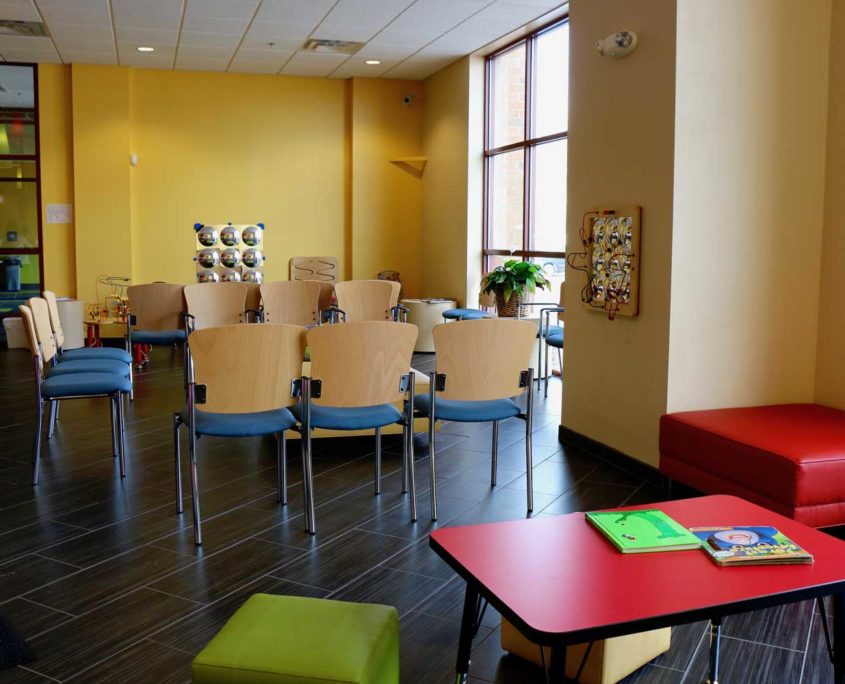
Closely linked to office culture is the actual office layout and design. Creating a space with the intention of making it welcome, comfortable and appealing is important, and KPP does this well. “The whole look of the office is by design,” says Hermann. “We went through this at every phase, from our logo to our website, to our offices. We tried to find the sweet spot of warm, playful, and kid-friendly without sacrificing authority and competence.” With its sleek furniture, great lighting, and pops of color on the walls, the KPP office is a place you want to spend time in. And that is just what they had in mind when they designed it… a space that provides a sense of comfort can be just as important as the comfort you get from the people in it.
Hermann and Dr. Wolynn go on to provide some other tips for practices that can’t necessarily afford a full design overhaul. Their first suggestion is that you can change an entire room with just two gallons of paint. You don’t need to hire a professional… you can do the work yourself. New paint looks fresh and clean. You don’t have to have cherry and oak furniture and granite counters. You can go to IKEA or Target and get nice and inexpensive chairs, toys, and side tables. Less is more. You can go minimal if you go bright. And you can often make your office look better by removing things rather than adding. For example, reducing clutter behind the front desk can streamline the look of the reception area.
Additionally, an office renovation is great fodder for your practice’s social media pages. KPP would update their office locations one by one, and post about it on Facebook with pictures and stories. People would comment online, and when then came into the actual space for their appointments. It became a conversation point and created engagement and interest in the practice.
With multiple physical locations and the standard of service they provide, KPP has worked to create a scalable brand. They have consistent features such as The Well and the Breastfeeding Center at each location, as well as a consistent look and feel with their paint colors and furniture choices. Patients can go to any location and have a similar experience in a similar atmosphere, which increases their sense of being at home in the practice. While practice locations may vary in size or layout, the design elements have a commonality that work to further the brand of KPP.
Despite everything they have going on, KPP makes sure to keep an eye on the future. Having a full pipeline is the key to staying current and innovative. They think about what they will need to bring to market in three to five years, basing decisions on things that parents need answers to but aren’t getting enough of currently. For example, with kids spending more and more time online, KPP wants to increase education around digital media literacy and safety.
Other plans include increasing mental health services. Dr. Wolynn has a pilot going embedding a mental health navigator into pediatric primary care. Currently there are not enough providers of substance abuse and mental health counseling working in pediatrics, and not enough kids receiving these services in general, whether in or outside of the pediatrician’s office. This can be due to a lack of availability of practitioners, a stigma to patients going outside of the medical home, billing codes that can’t be used, and the silos of mental health versus physical health that sometimes negate providers treating both simultaneously. But Dr. Wolynn feels strongly that kids need to get mental health services where they already have an established sense of trust and care – their pediatrician’s office. “Pediatricians have a golden opportunity to begin [providing mental health services] where someone trusts you with the life of their child [the pediatrician’s office],” he says. “If you reduce yourself to sick and well care only, you miss this opportunity.”
Dr. Wolynn is currently working to integrate licensed clinical social workers into the practice. They will be able to get credentialed with insurance companies, and have their services billed out. This will allow KPP to “close the loop” with in-house care. Already into the third year as a Level 3 Patient-Centered Medical Home (PCMH), they had been using clinical care coordinators to connect patients with mental health providers in the community. But patients would not always follow through and make appointments with them. Lack of patient compliance is all too common when referring out to specialists. Having in-house social workers would not negate the need for clinical care coordinators. Rather, they could work in tandem to organize and provide the care they need. Social workers are also trained to address more than mental health issues; they are well-suited to intervene around food or housing insecurity issues as well. This adds to the holistic approach that KPP is working toward providing all patients.
As far as other trends Dr. Wolynn sees coming down the pike, he shares: “Social determinants of health worry me. Other countries spend half of what we do on healthcare, but more on social spending [to address things like] housing and food insecurity, toxic stress, adverse childhood experiences. These are the things that impact kids into adulthood. A lot of our work is addressing that much more comprehensive picture. We’re a destination, a community engagement space. We are trusted. We want to help you address all these other things.”
KPP does a great job providing all kinds of resources to address the big picture of kids’ health and community engagement. But, as Dr. Wolynn says, things like The Well are great, but they come with a cost. “If you offer a better product, you get more money in most fields. But with insurance companies, you offer a better product and you still get the same amount for it.”
Commenting on the current state of healthcare, Dr. Wolynn says: “There is no slack in the system anymore. With more layers of regulations and compliance, and technology, expenses go up every year. What we are seeing now with contracts for pediatricians, is that they can’t measure value very well in pediatrics. You get held to well visit rates and immunizations information. Pediatrics is the gateway to the rest of health…we impact outcomes down the road. With payments for quality of care or preventive care, you don’t see the dollars shifting. The money isn’t going up, it’s going down. Things are so tight. Other groups we know are taking austerity measures – laying off staff, reducing office supplies.”
This state of affairs is one of the reasons Dr. Wolynn stresses the importance of adding all of the additional services to a practice. With insurance payments for visits declining, it’s important to have other offerings that can pick up the slack. “You can be the best pediatric practice in the world, but if you get closed out of the loop, you can still cave to being bought out,” he says.
We covered a lot of ground during our day with KPP. This forward-thinking practice packages together cutting-edge clinical care with an entrepreneurial vision for community building.
Here are six of our overall takeaways:
Takeaway 1: Running your practice like a business doesn’t have to be drudgery. Think of it as the art, science, and business of medicine.
Takeaway 2: Your mindset counts for a lot. Success follows when you:
Takeaway 3: Put these first and the revenue follows:
Takeaway 4: Work toward making your practice a destination for patients and the community. Not just a place for sick or well visits, but a destination for classes, events, social networking and support. A place where people want to be and not just have to be.
Takeaway 5: Continually look to the future and take preemptive action to ensure you stay current in what you offer to patients and their families.
Takeaway 6: If you can’t convince Hermann to be your communications director, we cannot overemphasize the importance of finding your own! Having someone oversee the vast array of internal and external communications via website, social media channels, videos, events, and the like is a powerful investment in running your practice like a business.
All in all, KPP is pretty darn inspiring. And what they do on a daily basis can be jaw-dropping. But it is important to remember that all of these things are scalable, and able to be adopted by anybody. None of what they do is out of reach. All of it can be learned and executed on.
But the key to all of it? You have to want it. You have to find and maintain an inner drive toward excellence. Not because you should do more online, not because you have to engage patients, not because you are required to meet certain measures, but because you want to. Once you find that inner motivation, complacency drops away and creativity takes its place.
When asked about his pain points or what ‘keeps him up at night,’ Dr. Wolynn grins and says: “It’s really about not having enough time to do everything we want to do. My to-do list is never less than 10 things long and my wish list is never less than 20.” Through those wishes and that sense of out-of-the-box thinking, KPP has created a place where people want to be…a destination where patients feel truly known, a go-to for thought leadership, and a place that fosters a deep-rooted sense of community.

What do you get when you bring a recovering academic with a passion for film into a pediatric practice? Nothing less than the perfect solution for Kids Plus Pediatrics’ communication needs.
Courtney Edelson is marketing content manager at Physician’s Computer Company (PCC). She writes for the PCC blog, and creates content to keep pediatricians up to date on important healthcare industry news and trends. In addition to being a lifelong writer, Edelson brings nearly a decade of healthcare practice management experience to her work.
Pediatric care is complex enough — navigating for the future shouldn’t be a solo journey. Join host Chip Hart and learn from pediatricians, industry leaders, and policymakers who are shaping the future of pediatric care. Every episode, we explore their stories, their dreams, and the joy they find in medicine. Together, we’re charting the future of children’s healthcare.

The Independent Pediatrician is brought to you by PCC, which provides tools and services to help pediatricians remain independent and in control of their practices.
PCC itself is a fiercely independent business. As a Benefit Corporation, it puts the interests of its clients, community, and employees on an equal footing with those of its shareholders.


 Spotlight on Chad Hermann, Kids Plus Pediatrics Communications Director