“Come Learn With Me:” Teaching the Next Generation of Pediatricians
Pediatric Associates at Mt. CarmelCincinnati, Ohio


Dr. Chris Peltier wants to help community pediatricians fall in love with teaching. He’s learned through more than two decades of experience as a pediatrician and preceptor at Pediatric Associates at Mt. Carmel, an independent practice in suburban Cincinnati, Ohio, how rewarding it is to help medical students and residents learn the art and science of pediatrics. He also knows it is possible to effectively teach while still meeting business objectives and offering top notch patient care. His goal is to bring pediatricians into the world of precepting by showing them how joyful the work can be – and that it doesn’t necessarily have to compete with their clinical practice.
“Teaching in the clinical setting, it’s always this balancing act between seeing the patients, diagnosing the patients, and taking good care of your patients while teaching the learner,” he says.
As an associate professor of pediatrics and director of the community section in the Division of General and Community Pediatrics at Cincinnati Children’s Hospital Medical Center, he is responsible for matching residents with practices for their continuity clinic, a unique feature of the residency program where trainees spend one day per week for the entire three years of the program at the same outpatient site. Out of the 50 new interns every year, “about one-third” complete this rotation at a community practice. In addition, he places residents for the one-month rotation they are required to complete in a private practice and helps medical students from the University of Cincinnati connect with community practices for their training.
He also precepts learners “probably 10 months out of the year” at Pediatric Associates at Mt. Carmel, a nine-doctor, three-office practice where he has treated patients for the past 22 years and has been a partner since 2001. His two roles — spanning the worlds of academia and private practice – make him an excellent mentor and role model for community pediatricians with an interest in teaching. He is uniquely positioned to address one of the most common pitfalls for this group when it comes to serving as a preceptor – finding the time. It can be done, says Dr. Peltier, and he emphasizes that it is vitally important to introduce the next generation to the joys of running a practice.
“I can teach you how to do it. I can show you how to do it,” he says. “That’s a unique perspective — hospital physicians who are clerkship directors or residency directors can’t say that because they’re not doing it every day. I think that’s one of the reasons our teaching program has been so successful here in Cincinnati.”
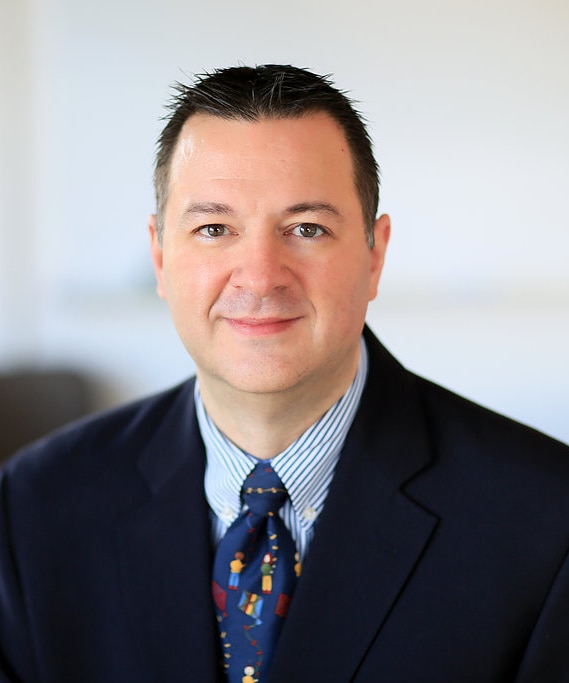
“I feel like I’m always learning from my learners. For me personally, it just energizes me. It’s a lot of fun.”Dr. Chris Peltier
Dr. Peltier developed a passion for teaching early on, while chief pediatric resident at Riley Hospital for Children in Indianapolis.
“That’s probably where I first got excited about teaching because we would lead educational conferences and we taught students and residents in the hospital,” he says. “That was really where I got that bug.”
During his time in medical school at University of Cincinnati College of Medicine, he completed an outpatient rotation at the same practice where he now works – Pediatric Associates at Mt. Carmel. He met Dr. Emanuel Doyne at this time, a practice partner and mentor who has proven instrumental to his career path. At the end of his chief residency year, he had the opportunity to return.
“My wife and I decided that we wanted to move back to Cincinnati after my residency,” he says. “My practice was interviewing and looking to hire and I was lucky enough to land back there. The only practice I’ve ever worked in.”
Dr. Doyne got him involved with teaching shortly after he joined the practice as a new physician. When Dr. Doyne began to look towards retirement, Dr. Peltier started to handle more of the work related to recruiting preceptors for medical students and residents. This prepared him to take on the director position he now holds with Cincinnati Children’s and the College of Medicine.
It’s been a lesson on the importance of mentorship, says Dr. Peltier.
“I owe my entire career to that one completely kismet moment of being assigned to [Pediatric Associates at Mt. Carmel] when I was a fourth-year medical student. It sent me on the path that I’m on today because somebody opened up their office and said, ‘Come learn with me. I’m going to spend a month with you and teach you.’ That changed my entire life.”Dr. Chris Peltier
Now, Dr. Peltier wants to make sure community pediatricians have the opportunity to do this rewarding work. That means addressing some of the challenges that come with running a private practice while teaching. The biggest sticking point: finding enough time in the day.
“When I’m talking to preceptors they [often] say, ‘I don’t have time to teach.’ Especially if your salary is paid by productivity,” says Dr. Peltier. “If having a learner slows you down, you’re not going to want to teach. Because you’re not making as much money doing that.”
Workshops offered through Cincinnati Children’s focused specifically on the needs of independent pediatricians have been key to bringing new preceptors into the fold, helping busy clinicians balance the work of teaching and running a business.
“We have lots of different faculty development offerings that teach pediatricians how to be good teachers,” he says. “And not only that, but how to do it efficiently and effectively when you’re in a busy practice seeing 25 patients a day.”
Teaching models such as the “One Minute Preceptor” can help physicians combine teaching and treating patients. In this model, the student goes into the patient’s room, takes a history, completes a physical exam, and then presents findings to the preceptor.
“It takes one minute and you can not only find out what’s going on with your patient, but you can do a teaching point,” says Dr. Peltier. Depending on the level of the learner, they may offer a potential diagnosis and treatment options.
Dr. Peltier counsels using the “Five W’s” for these teachable moments with a learner: The “what, why, when, whoops, and warm fuzzy.”
“The first one is ‘what’ – you get them to make a commitment,” he says. “I think this patient has strep throat. Well, why? Tell me why you think that. Well, they have sore throat, fever. The sibling has strep throat. And when I look in the back of their throat, they have puss back there. Great. Then the ‘when’ is that teachable moment. You say, ‘Okay, well, what do you want to do?’ And they may say, ‘I want to put them on amoxicillin.’”
Complications may arise as the learner walks through assessment and diagnosis. In the case of the patient with strep throat, Dr. Peltier uses the example of reminding them to screen for any penicillin allergies, as well as consider the patient’s insurance coverage as related to the cost of specific medications.
“The ‘whoops’ is correcting what they may have done wrong,” he says. “And then the warm fuzzies remind them of what they did well.”
This method combines didactic lessons with actual patient care to help cement the new knowledge in the mind of the student. Recent changes to coding guidelines now allow preceptors to refer to a medical student’s documentation of history, insteading of requiring them to re-document in the chart, which opens up additional teaching opportunities in the patient exam room.
“They can chart for me while I’m in that room,” says Dr. Peltier. “I’m modeling. I may be showing them how to communicate difficult news to a patient. They can watch and we’ll talk about that afterwards, but I’m also having them do some work. I’m having them chart for me.”
Sometimes, he will turn the tables and chart while the learner interacts with the family.
“I’m being efficient, which allows me to watch how a learner takes a history and does a physical exam,” he says. “I’m seeing exactly what they’re doing well and maybe what I would have them do differently. And I’m charting at the same time.”
For Dr. Peltier, the time he spends with learners enriches his work with patients. Since like many community pediatricians he doesn’t round in the hospital or practice in an acute care setting, he can ask residents about what they’re seeing in the emergency department or on hospital wards, helping him to stay current.
“I feel like I’m always learning from my learners,” he says. “For me personally, it just energizes me. It’s a lot of fun.”
The COVID-19 pandemic upended the learning environment in many ways. For a period of several months in early 2020, rotations for medical students were suspended. Lectures and other educational experiences transitioned to a virtual model. Although some residents rotating in hospitals continued to see patients in-person, Dr. Peltier says many outpatient settings put a hold on any educational activity as they prioritized protecting staff and patients from the potential spread of COVID-19.
The fall-out from the pandemic continues to affect medical education, he says. The cohort of learners who rotated through clinical settings during the pandemic haven’t had the opportunity to see and treat the typical number of patients with common diseases like the flu and bronchiolitis. The adoption of social distancing measures and the emphasis on hand washing and mask wearing have translated into a low volume of ill patients.
“We now have an entire class of first-year pediatric residents who have completed their first year of training without really touching patients with bronchiolitis or influenza,” he says. “Soon they are going to be supervising junior learners, so there’s definitely some concern about how the pandemic has affected learning because some of the typical diseases that we see in the wintertime, we just weren’t seeing this last year.”
While the volume of patients presenting with infectious diseases is down, there’s been a spike in inpatient psychiatric admissions, an uptick hospital leaders attribute in part to stress from the pandemic. Dr. Peltier notes an increase in the intensity of the disorders he is seeing; for example, more severe anxiety and depression requiring a higher level of clinical care.
“Cincinnati Children’s has one of the largest inpatient child psych facilities in the country,” he says. “About a month or so ago, there were 26 patients either on a traditional medical floor or holding in the ED, waiting for a psych bed. And that hospital has probably about 100 psych beds.”
As president-elect of the Ohio chapter of the American Academy of Pediatrics (AAP), Dr. Peltier sees opportunities to address major challenges like mental health. A new project, called Store It Safe: Adolescent Suicide Prevention Program, aims to raise awareness as well as promote depression screening and prevention. The chapter has partnered with pediatricians, gun advocacy groups, police departments and schools to distribute gun lock boxes and information about the risks related to teens and firearms. Evidence shows that if guns in the home are appropriately stored and locked, teens suffering from depression or other mental health issues are much less likely to engage in a fatal suicide attempt.
Dr. Peltier has also served as part of the team presenting COVID-19 information to the public during press conferences with Ohio Governor Mike DeWine. Part of his message has been the importance of routine care for children, including well-child visits and developmental screenings, even during the pandemic.
“We created a toolkit for pediatricians and marketing to families,” he says. “Our hashtag was #SafePedsHealthyKids.”
In addition to public health messaging, he’s focused on giving voice to independent practices, amplifying what they need to survive during a time when the pandemic has put pressure on businesses already straining from hospital take-overs and other financial challenges.
“Many general pediatricians [and] primary care pediatricians have been president of the Ohio AAP,” he says. “I’m probably the first in 25 years that is an independent practice pediatrician.”
Part of the solution is to introduce new pediatricians to independent practice, says Dr. Peltier. When they have the opportunity to get to know this type of practice during their training, they’re more likely to consider it as a career.
“It is vital that we expose pediatric residents to what we do,” he says. “The majority of their time they’re spending in a hospital setting or a clinic that’s owned and run by a hospital. When I graduated residency, I had no clue how to run a business. I’m still not sure I know how to run a business, but I’ve learned a lot in 22 years. One of our goals, especially here in Cincinnati, is to try to show the benefits of owning your own practice. And that it’s not as scary as it may seem, and that we want to teach you.”
The strategy has paid off, as his practice recently recruited a physician who completed rotations at Pediatric Associates at Mt. Carmel during her child psychiatry residency.
“She was with us once a week for five years,” he says. “We’ve hired her to be our first child psychiatrist. And it was because we had that relationship with her. That’s the goal as we see more and more practices close or sell. We’re starting to see Cincinnati Children’s start to acquire some practices here in town and we really want to advocate for keeping practices independent.”
Supporting preceptors in the community by helping them to fine tune their teaching skills is one more way to keep independent practices strong, says Dr. Peltier. Through these rotations, members of the next generation of pediatricians learn the business of pediatrics as well as appreciate the rewards of running a practice.
“Eventually I’m going to retire and I want somebody to take my place,” he says. “We want independent practices to thrive and continue. So that, to me, is a huge plus of why we do what we do.”
Dr. Peltier recommends that community pediatricians interested in precepting reach out to their local medical school or pediatric residency program/children’s hospital. He’s also available to answer questions at chris.peltier@cchmc.org. He’ll be presenting a virtual on-demand session at the American Academy of Pediatrics National Conference and Exhibition in October titled “How to Effectively and Efficiently Teach Students and Residents in the Busy Community Office Setting.”
A resident of Burlington, VT, Erin Post has a BA degree in English from Hamilton College, and is a graduate of the writing program at the Salt Institute for Documentary Studies. She is currently working on her master’s in public health at the University of Vermont. In her spare time, she likes to bike, ski, hike, and generally enjoy the Green Mountains of Vermont.
Pediatric care is complex enough — navigating for the future shouldn’t be a solo journey. Join host Chip Hart and learn from pediatricians, industry leaders, and policymakers who are shaping the future of pediatric care. Every episode, we explore their stories, their dreams, and the joy they find in medicine. Together, we’re charting the future of children’s healthcare.

The Independent Pediatrician is brought to you by PCC, which provides tools and services to help pediatricians remain independent and in control of their practices.
PCC itself is a fiercely independent business. As a Benefit Corporation, it puts the interests of its clients, community, and employees on an equal footing with those of its shareholders.

 Building Community Ties in the Spindle City: Pediatric Associates of Fall R...